Make the reasoning behind product work visible.
Agentic Dialectic helps teams turn fragmented evidence, conflicting priorities, and unresolved assumptions into a direction they can defend - and keeps that reasoning connected to the brief, requirements, prototype, and revisions that follow.
The problem is not insufficient output. It is the loss of context, disagreement, and decision logic underneath it. AD preserves that reasoning as work moves from initial inputs through execution and revision.
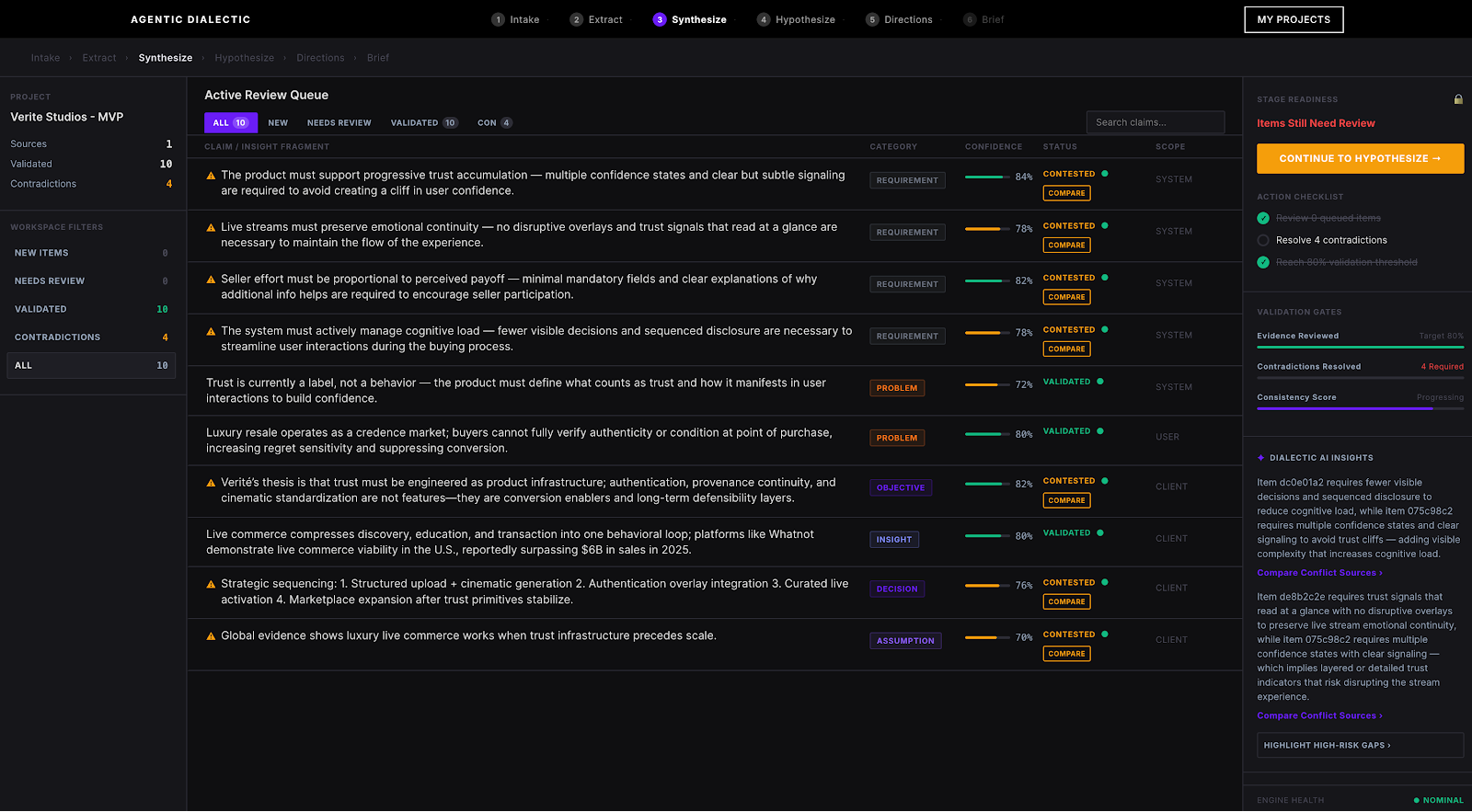
Structured reasoning under uncertainty.
Agentic Dialectic treats ambiguity as useful information rather than a problem to eliminate. Evidence, assumptions, interpretations, and preferences must remain distinguishable - because collapsing them into confident prose is where most product decisions start to fail.
Opposition can reveal the limits of an accepted frame. AI can extract, compare, challenge, and preserve context at a level of granularity that is difficult to do manually. Humans decide what becomes committed. Committed decisions govern what moves downstream.
Separate evidence, assumptions, interpretations, preferences, and unresolved questions before they become direction. A high-confidence assumption is still an assumption.
Keep claims connected to their sources, contributors, challenges, validation status, and downstream decisions. Traceability reveals not only what supported a decision, but whose evidence was recognized and who had the authority to commit it.
Surface contradiction, counterevidence, competing interpretations, and weak assumptions rather than smoothing them into false alignment. Unresolved tension is information.
AI may structure the argument, but people accept, reject, revise, and own what the system carries forward. Validation changes what the system treats as committed.
Generate briefs, requirements, and prototype instructions from validated decisions - not flattened summaries or unreviewed context.
Use prototype findings and new evidence to update requirements and decisions while preserving the original state and rationale. Prior versions stay inspectable.
One connected path from raw context to a prototype that can still show why it exists.
Eight stages form one reasoning and execution loop. Every decision made in the early stages stays traceable through the brief, the requirements, the prototype, and every revision that follows.
One connected reasoning and execution loop. Eight stages carry a project from raw context through prototype revision, with every decision traceable to the evidence and judgment that produced it. These are not separate products - they are sequential stages of one system.
Capture the original idea, project materials, stakeholder inputs, research, constraints, references, and open questions in their native form.
Identify and classify the claims, evidence, assumptions, goals, constraints, contradictions, risks, and unresolved questions inside those inputs.
Organize validated inputs into themes, relationships, patterns, gaps, and tensions without prematurely resolving disagreement.
Develop multiple plausible interpretations or directions, showing what supports each, what it assumes, and what remains unresolved.
Require a human to compare the hypotheses and commit to a direction, including what is accepted, rejected, deferred, or still contested.
Translate the committed direction into a structured, execution-ready brief while preserving links to the evidence and decisions behind it.
Convert the brief into traceable requirements and a controlled build package for external design or coding tools. Reconcile the resulting prototype against the PRD and original intent.
Use prototype findings, feedback, and new evidence to revise the requirements or direction. Preserve prior versions, identify material conflicts, and require human approval when a committed decision changes.
Built for people turning ideas into something real.
The first users are senior product and strategy leaders inside agencies and consultancies, where fragmented client inputs, political authority, and expensive handoffs create immediate risk. But the larger opportunity is to make the strategic support of a well-resourced team available to more people.
Turn contradictory client inputs into a defensible direction before ambiguity becomes scope, rework, and margin loss.
Work with the structure, memory, and challenge of a larger team without surrendering creative authority or flattening the idea.
Move from an early idea to an executable product direction without having every specialist in the room from day one.
Gain greater access to methods, reasoning support, and quality standards traditionally concentrated inside expensive institutions and culturally privileged networks.
AI is lowering the cost of making things. AD is designed to lower the barrier to developing an idea with rigor, while preserving the perspective that made it worth building.
Bring a complex project, an unresolved idea, or a brief no one fully trusts. See what changes when the reasoning becomes visible.